worksheet std 7th
L-1 HEAT
Q.1. State whether true of false
1. The range of laboratory thermometer is from - 100C to 1100 C.
Ans : ______________________________________________________________
2. Temperature of our body can be measured by the help of clinical thermometer.
Ans : ______________________________________________________________
3. The materials which allow heat to pass through them easily are known as conductors.
Ans : ______________________________________________________________
4. We use iron utensils to cook food, because iron is a good conductor of heat.
Ans : ______________________________________________________________
5. We use woolen and dark coloured clothes during winter.
Ans : ______________________________________________________________
Q2. Fill in the blanks.
i. The hotness of an object is determined by its .
ii. Temperature is measured in degree .
iv. iii Land breeze blows during .
Vi Sea breeze blows during .
v. Dark coloured clothes are preferred during .
vi. Poor conductors are known as .
Q3 .Match the following :
Column I Column II
1. Land breeze flows during a. Summer
2. Sea breeze flows during b. Winter
3. Dark coloured clothes are preferred during. c. Day
4. Light coloured clothes are preferred during. d. Night
Q.4 True/False
i. Temperature of boiling water cannot be measured by a clinical thermometer.
ii. Medium is required for transfer of heat by the process of radiation.
iii. Clothes of dark colours absorb heat better than clothes of light colours.
iv. Light coloured clothes are preferred during summer.
v. We should hold the thermometer by the bulb while holding it.
vi. The bulb of laboratory thermometer should not touch the bottom or the sides of the container.
Q5. What is that silver stuff in a thermometer?
Ans.
Q6. What is the unit of temperature?
Ans.
Q7. What is Conduction?
Ans.
Q8. What are insulators of heat?
Ans.
Q9. Explain land breeze.
Ans
Ans :
L2-Acids, Bases and Salts
Q.1 Match the following.
Column I Column II
a) An antacid i) Formic acid
b) An Ant ii) Milk of magnesia
c) China Rose iii) Turns red litmus blue.
d) An acid iv) A natural indicator
e) A base v) Turns blue litmus red
Q2. Fill in the blanks.
i. Change of colour in an acid and a base depends on the type of the .
ii. Acid turns litmus red.
iii. Bases turn litmus blue.
iv. Litmus has a colour in distilled water.
v. In neutralisation reaction a new substance is formed. This is called .
vi. Lemon juice is in nature.
Q3. What is acid rain?
Ans.
Q4. True/False
i. Nitric acid turns red litmus blue.
ii. Sodium hydroxide turns blue litmus red.
iii. Sodium hydroxide and hydrochloric acid neutralise each other and form salt and water.
iv. Indicator is a substance which shows different colours in acidic and basic solutions.
v. Tooth decay is caused by the presence of a base.
Q5. What is the role of hydrochloric acid in the stomach?
Ans.
Q6. What is the nature of soap solution?
Ans
Q7. Why curd, lemon juice, orange juice and vinegar taste sour?
Ans.
Q.8 Complete the following table
S.No. Name of Substance Litmus used Colour change
1 Curd Red No change
2. Salt Blue
3. Lime water Red
4. Lemon Juice Blue
5. Window Cleaner Blue
6. Sugar Red
7. Vinegar Blue
8. Baking soda Blue
Q9. How acidic soil can be treated?
Ans
Q10. State the nature of baking soda.
Ans
L3-Physical And Chemical Changes
Q.4 Q1. Answer the multiple choice questions
1. 1.Properties which are affected during physical change :
a a. Colour b. Shape c. Size d. All of the above
2. Which of the following is not an example of crystallization :
a. Salt obtained from sea water b. Snow flakes formation c. Crystallization of sugar from sugar syrup. d. Rusting of iron.
3. Example of chemical change is :
a. Dissolving sugar in water b. Formation of clouds c. Cooking of food d. Cutting of trees
4. Which of the following can accompany a chemical change :
a. Heat b. Sound c. Gas d. All of the above
5. Which of the following is an alloy :
a. Copper b. Steel c. Zinc d. Aluminium
1. 1.Properties which are affected during physical change :
a a. Colour b. Shape c. Size d. All of the above
2. Which of the following is not an example of crystallization :
a. Salt obtained from sea water b. Snow flakes formation c. Crystallization of sugar from sugar syrup. d. Rusting of iron.
3. Example of chemical change is :
a. Dissolving sugar in water b. Formation of clouds c. Cooking of food d. Cutting of trees
4. Which of the following can accompany a chemical change :
a. Heat b. Sound c. Gas d. All of the above
5. Which of the following is an alloy :
a. Copper b. Steel c. Zinc d. Aluminium
Q2. Fill in the blanks.
i. Cutting a log of wood into pieces is a change.
ii. Condensation is a change.
iii. When carbon dioxide is passed through lime water, it turns milky due to the formation of .
iv. Two methods by which rusting of iron can be prevented are .
v. Changes in which only properties of a substance change are called physical changes.
Q3. True/False
i. Formation of manure from leaves is a physical change.
ii. Iron pipes coated with zinc do not get rusted easily.
iii. Iron and rust are the same substances.
iv. The chemical name of baking soda is Sodium hydrogencarbonate.
v. Changes in which new substances are formed are called chemical change.
Q4. What type of change is crystallisation?
Ans.
Q5. What type of change is involved in rusting of iron?
Ans.
Q6 Name the two methods by which rusting of iron can be prevented.
Ans.
Q7. What type of change is crystallisation?
Ans
Q8.. Why souring of milk is a chemical change?
Ans
Q9. What is rust?
Ans.
Q10. Which technique is better for obtaining sugar from sugar solution?
Ans
L-4 Motion and Time
Q1. Fill in the blanks.
i. An image that cannot be obtained on a screen is called .
ii. Image formed by a convex is always virtual and smaller in size.
iii. An image formed by a mirror is always of the same size as that of the object.
iv. An image which can be obtained on a screen is called a image.
v. An image formed by a concave cannot be obtained on a screen.
vi. A virtual image larger than the object can be produced by a
Q2. True/False
i. We can obtain an enlarged and erect image by a convex mirror.
ii. A concave lens always form a virtual image.
iii. We can obtain a real, enlarged and inverted image by a concave mirror. T
iv. A real image cannot be obtained on a screen.
v. A concave mirror always form a real image.
Q3. Which type of mirror can form a real image?
Ans.
Q4. Which type of lens forms always a virtual image?
Ans.
Q5. Give an example of a curved mirror.
Ans.
Q6. What are the two types of spherical mirror?
Ans.
Q7. What is real image?
Ans
Q8. Write some uses of lenses.
Ans.
Q9. What is convex mirror?
Ans.
Q10. Name the following.
L-5 Motion and Time
Q2. Fill in the blanks.
i. The metallic ball is called the of the pendulum.
ii. The symbols of all units are written in .
iii. The time taken by the pendulum to complete one oscillation is called its .
iv. One microsecond is one of a second.
v. A nanosecond is one of a second.
vi. The distance-time graph for the motion of an object moving with a constant speed is
Q3. What is average speed?
Ans.
Q.4. Here are a few units of time. Arrange them in a ascending order
Second, day, year, month, munutes, hour
........... < ............ < ............... < ............... < ............ < .............
Q5. True/False
i. The basic unit of time is second.
ii. Every object moves with a constant speed.
iii. Distances between two cities are measured in kilometres.
iv. The time period of a given pendulum is not constant.
v. The speed of a train is expressed in m/h.
vi. Clocks that measure such small time intervals are used for scientific research.
Q6. What are quartz clocks?
Ans
Q7. What is a simple pendulum?
Ans.
Q8. What is non-uniform motion?
Ans
Q9. What is motion?
Ans.
Q10. What is speed?
Ans.
L-6 Motion and Time
Q1. State True (T) or False (F).
ii. Every object moves with a constant speed. _________
iii. Distances between two cities are measured in kilometres. _________
iv. The time period of a given pendulum is not constant. _________
v. The speed of a train is expressed in m/h. _________
vi. Clocks that measure such small time intervals are used for scientific research. _________
Q2. Fill in the blanks.
i. The metallic ball is called the _________ of the pendulum.
ii. The symbols of all units are written in ________________.
iii. The time taken by the pendulum to complete one oscillation is called its__________________.
iv. One microsecond is one _______________ of a second.
v. A nanosecond is one ________________of a second.
vi. The distance-time graph for the motion of an object moving with a constant speed is a _____________________.
Q3 What is the basic unit of time?
Ans.
Q4. What is the basic unit of speed?
Ans.
Q5. What is speedometer?
Ans.
L-7 Electric Current and its effects.
Q1. Fill in the blanks.
i. Longer line in the symbol for a cell represents its terminal.
ii. The combination of two or more cells is called a .
iii. When current is switched ‘on’ in a room heater, it .
iv. The safety device based on the heating effect of electric current is called a .
Q2.Match the following :
Column I Column II
1. MCB a. Nichrome
2. ISI mark b. Miniature Circuit Breaker
3. CFL c. Tungsten 4. Element d. Compact Fluorescent Lamps
5. Filament e. Bureau of Indian Standards
Q3. True/False
i. To make a battery of two cells, the negative terminal of one cell is connected to the negative terminal of the other cell.
ii. When the electric current through the fuse exceeds a certain limit, the fuse wire melts and breaks.
iii. An electromagnet does not attract a piece of iron.
iv. An electric bell has an electromagnet.
Q.4 Write the symbol for the following Electric components
1. Electric Cell ...............................
2. Electric Bulb ...............................
3. Switch ‘ON’ ...............................
4. Switch ‘Off’ ...............................
5. Battery ..............................
6. Wire ...............................
Q5. What is electric current?
Ans.
Q6. Who discovered magnetic effect of current?
Ans.
Q7. What is filament?
Ans
Q8. When an electric current flows through a copper wire AB as shown in the figure
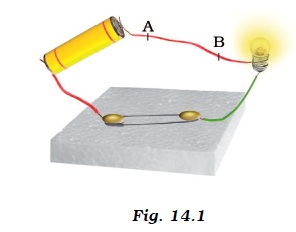
a)behaves like a fuse
b)becomes red hot
c)gives electric shock
Q9. What is the heating effect of the electric current?
Ans
Q10. Name any two effects of electric current.
Ans
L-8 Forests : Our Lifeline
Q1. Fill in the blanks.
i. The insects, butterflies, honeybees and birds help flowering plants in .
ii. A forest is a purifier of and .
iii. Herbs form the layer in the forest.
iv. The decaying leaves and animal droppings in a forest enrich the .
Q2. True/False
i. Forests protect the soil from erosion.
ii. Plants and animals in a forest are not dependent on one another.
iii. Forests influence the climate and water cycle.
iv. Soil helps forests to grow and regenerate.
Q3. List any five products we get from forests
i) ............................ ii) ............................. iii) ...........................
iv) .......................... v) .............................
Q4. Which of the following is not a forest product?
(i) Gum (ii) Plywood (iii) Sealing wax (iv) Kerosene
Q5. What is known as the crown of the tree?
Ans.
Q6. What is canopy?
Ans.
Q7. Why does the forest floor seem to be dark-coloured?
Ans
Q8. Why forests are called green lungs?
Ans;
Q9. Micro-organisms act upon the dead plants to produce
(i) sand (ii) mushrooms (iii) humus (iv) wood
Ans
Q10. List five products we get from forests.
Ans
L-9 Waste Water Story
Q1. Fill in the blanks.
i. Cleaning of water is a process of removing .
ii. Wastewater released by houses is called .
iii. Dried is used as manure.
iv. Drains get blocked by and .
v. By-products of wastewater treatment are and .
Q2. True/False
i. Clean water is a basic need of human being.
ii. Used water is clean water.
iii. Treatment plants reduce pollutants in wastewater to a level where nature can take care of it.
iv. Open drain system is a breeding place for flies, mosquitoes and organisms which cause diseases.
v. People should defecate in the open.
Q3. Which day is celebrated as World Water Day?
Ans.
Q4. Name two chemicals used to disinfect water.
Ans.
Q5. What is sewerage?
Ans.
Q6. Why chemicals should not be thrown down the drain?
L-10 Acids, Bases and Salts
Q1. State True (T) or false (F).
i. Nitric acid turns red litmus blue. ________
ii. Sodium hydroxide turns blue litmus red. ___________
iii. Sodium hydroxide and hydrochloric acid neutralise each other and form salt and water. _________
iv. Indicator is a substance which shows different colours in acidic and basic solutions. _________
v. Tooth decay is caused by the presence of a base. ________
vi. If an indicator changes colour with a base, it does not change colour with an acid. ________
Q2. Fill in the blanks.
i. Change of colour in an acid and a base depends on the type of the _______________.
ii. Acid turns _________litmus red.
iii. Bases turn __________litmus blue.
iv. Litmus has a _______________________colour in distilled water.
v. In neutralisation reaction a new substance is formed. This is called__________.
Q.ANSWER THE FOLLOWING
